


 FREE Delivery over £35
 Unbeatable Prices
Free SWOT Template: How to Create a SWOT Analysis
A SWOT analysis is a simple but powerful way to assess your strengths, weaknesses, opportunities and threats in one clear framework. Our free printable SWOT template allows you to organise ideas, spot priorities and turn your insights into practical next steps.
Free SWOT Analysis Template
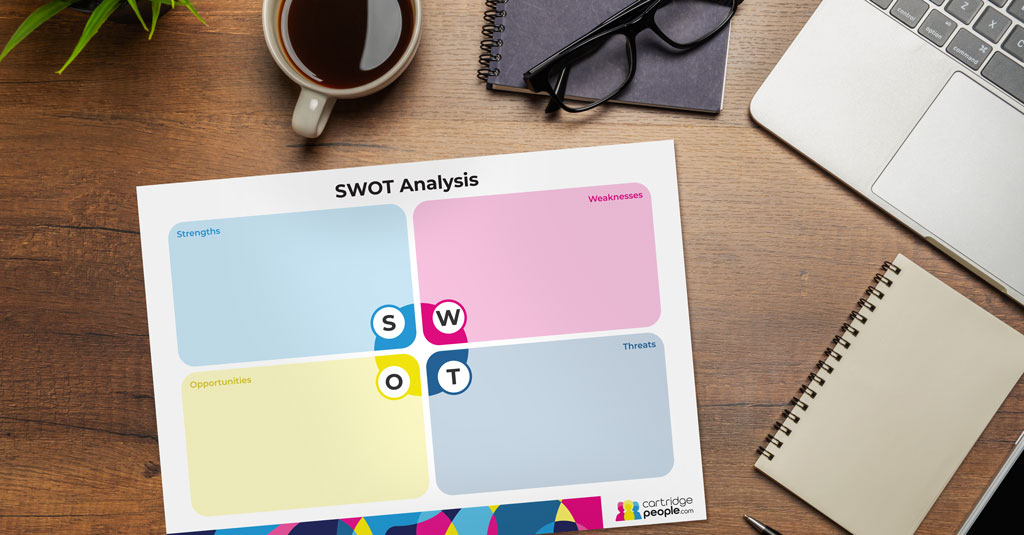
Often used as a great planning tool, the SWOT analysis template allows businesses to plan and prepare for the future of their project/business. It is made up of four sections: strengths, weaknesses, opportunities and threats. Download and edit or print our SWOT matrix template below for a ready-made layout to organise points clearly and support future planning and decision making.
What is a SWOT Analysis?
You may have already noticed but a SWOT Analysis is actually an acronym for Strengths, Weaknesses, Opportunities and Threats related to a business, project or idea. Within the strengths and weaknesses sections, it focuses on internal factors such as skills, resources or limitations. Whereas opportunities and threats look at external factors such as competitors, market trends or risks.
How to Complete a SWOT Analysis Template
Strengths
Strengths in a SWOT analysis are the internal advantages that help a business, project or organisation succeed. These can include skilled employees, a strong brand reputation, loyal customers, unique products, efficient processes, valuable resources or specialist expertise. When identifying SWOT analysis strengths, focus on what you do well, what gives you an advantage over competitors and which internal resources support your goals. Here are some prompts below to help you get started:
- What does your business do particularly well?
- What advantages do you have over competitors?
- What skills or expertise does your team have?
- Which products or services perform best?
- What do customers value about the business?
- What resources, skills or expertise set you apart?
Weaknesses
Identifying internal weaknesses within your business or project helps you understand where improvements are needed and where additional support, investment or changes could strengthen the performance. Weaknesses will be any internal factors that may hold a business or project back from achieving its goals. This could be things such as limited resources, skill gaps, inefficient processes, low brand awareness, outdated technology or poor customer retention.
- Where are resources limited?
- Which processes could be improved?
- Where do competitors perform better?
- What do customers complain about most often?
- Is your brand awareness weaker than it should be?
Opportunities
Opportunities in a SWOT analysis are external factors that could help a business, project or organisation grow, improve or achieve its goals. Examples of opportunities could include new market trends, changes in customer needs, gaps in the market or new sales channels. By identifying external opportunities, it helps you to understand where future growth and competitive advantage is possible.
- Are customer needs changing?
- Are there new markets or audiences to target?
- Could new technology create opportunities?
- Could we launch a new product or service?
- Are there new sales channels we could use?
Threats
When completing a SWOT matrix, threats are external risks or challenges that could negatively affect a project, organisation or business. Threats could include rising costs, supply chain disruption, increased competition or new regulations. Planning for these threats with a SWOT template allows you to reduce their impact on future performance.
- What are competitors doing?
- Are costs or regulations changing?
- Are there new businesses entering the market?
- Could seasonal changes impact demand?
- Could changing customer behaviour affect demand?
SWOT Analysis Example
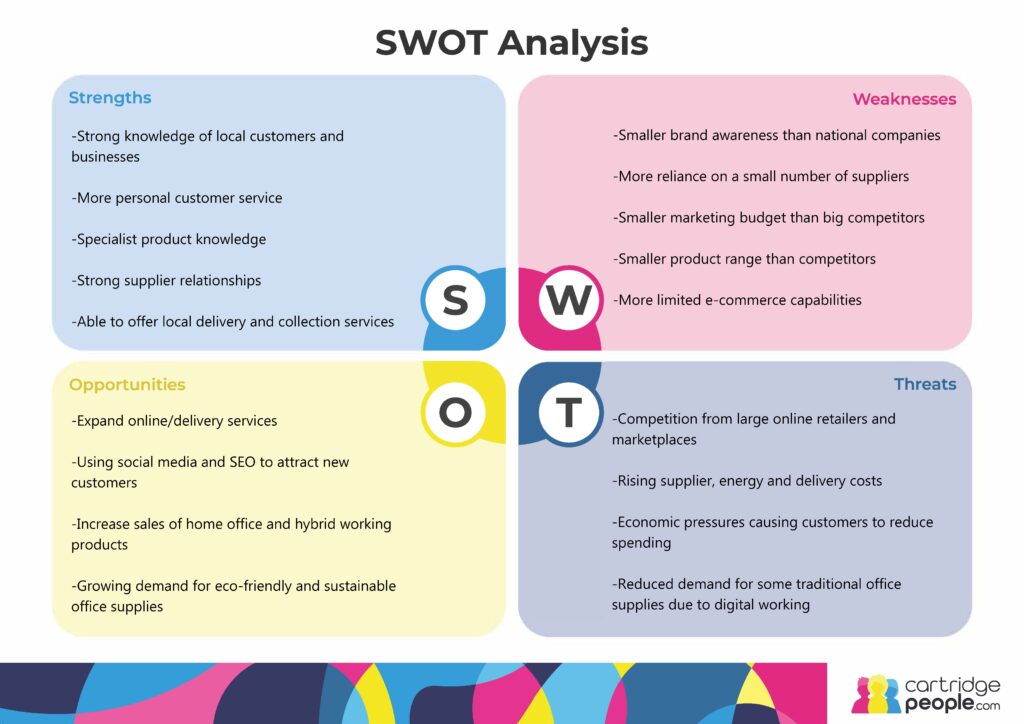
Below is an example of a small independent Office Supplies retailer. From using the SWOT template we can see they are a very local small-scale business, which means customer experiences are very personal and they may have strong knowledge in their area. However, this can also be a weakness if they wish to grow as a company. As we can see from the weaknesses section of the SWOT matrix, they will have less brand awareness outside the local area, as well as a greater reliance on a small number of suppliers. The Opportunities section shows us that they could attract new customers by using social media and expanding their online ordering and delivery services, whilst rising costs and competition from larger retailers are threats to monitor.
How to Use Your SWOT Analysis
Using our SWOT analysis template is only the first step. The real value comes from using your findings to guide future decisions, set priorities and create practical actions for your business.
Take a look at your final SWOT Analysis and identify your key strengths. These are perhaps the most important factors as you can build on them. Any significant weaknesses you can choose to address moving forward. Perhaps there are changes you could make to eradicate them. Opportunities are perfect for helping to set future goals. Look at achievable and realistic opportunities which are most likely to support the growth and future-proofing of the company. You should address any immediate threats and plan ways to reduce the risk or prepare for them. After you’ve evaluated all these sections, you should use your findings to create a list of priorities, specific actions and future objectives for the business or project moving forward.
Tips for an Effective SWOT Analysis
A well-structured SWOT analysis can help you identify priorities and make more informed business decisions. Therefore, to get the best value out of it, make sure to use specific data and keep it focused and relevant. We’ve put together our best tips below for an effective SWOT analysis.
Review regularly: Customer needs, competitors, market trends and business conditions can all change, so regularly review and update where necessary.
Be specific: Avoid vague statements and clearly explain each strength, weakness, opportunity and threat with data where possible.
Include evidence: Support your points with data where possible. Examples could include customer feedback, sales data and market research.
Prioritise the most important factors: Instead of filling every space in the SWOT matrix, focus on the issues that could have the greatest impact.
Involve different team members: Gathering input from the wider team creates a broader and more balanced perspective.
Keep internal and external factors separate: Make sure to keep internal and external factors distinct. Strengths and weaknesses focus on internal factors whilst opportunities and threats should relate to external factors.


You should now know what a SWOT analysis is and how it can be a beneficial tool for your business or project. Our free downloadable SWOT analysis template allows you to see the clear quadrant SWOT matrix made up of strengths, weaknesses, opportunities and threats. Why not try printing on photo paper and make a professional-looking plan or use highlighters to define your top-priority tasks?
SWOT Template FAQs
About The Author
